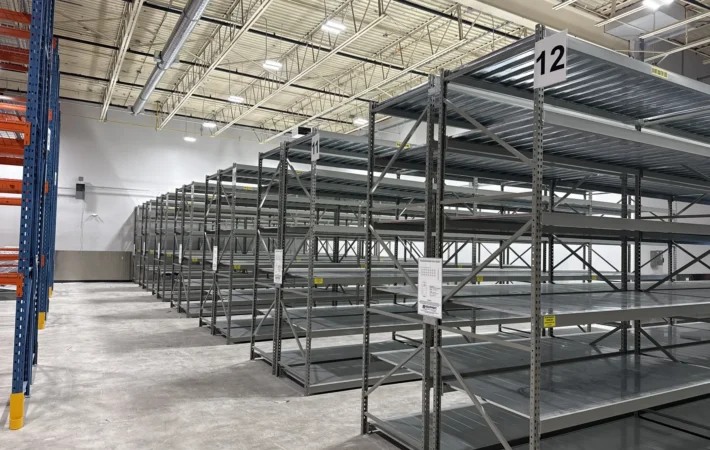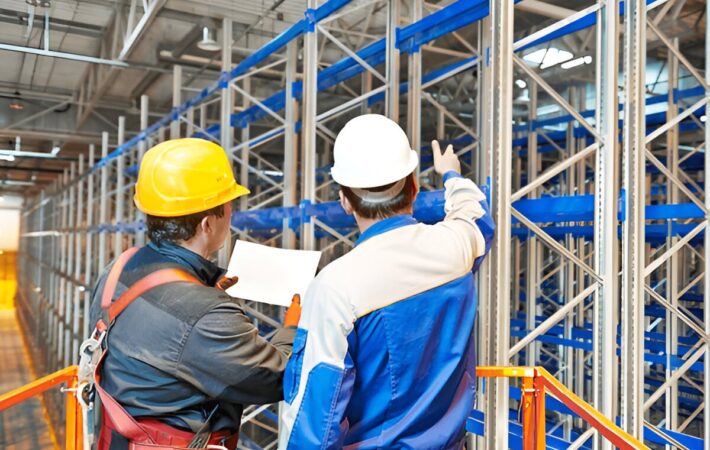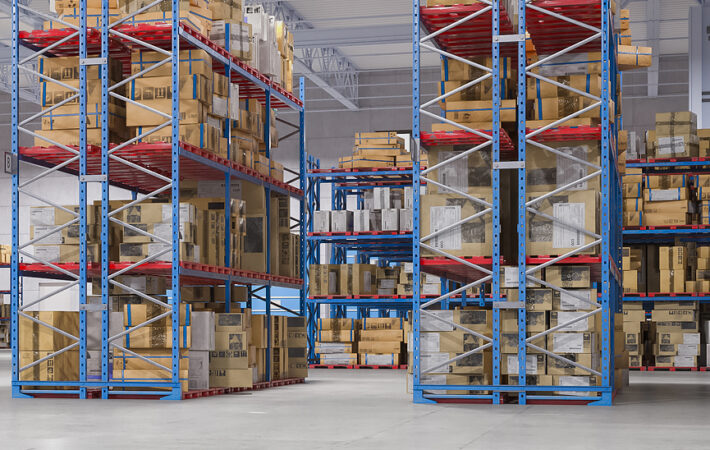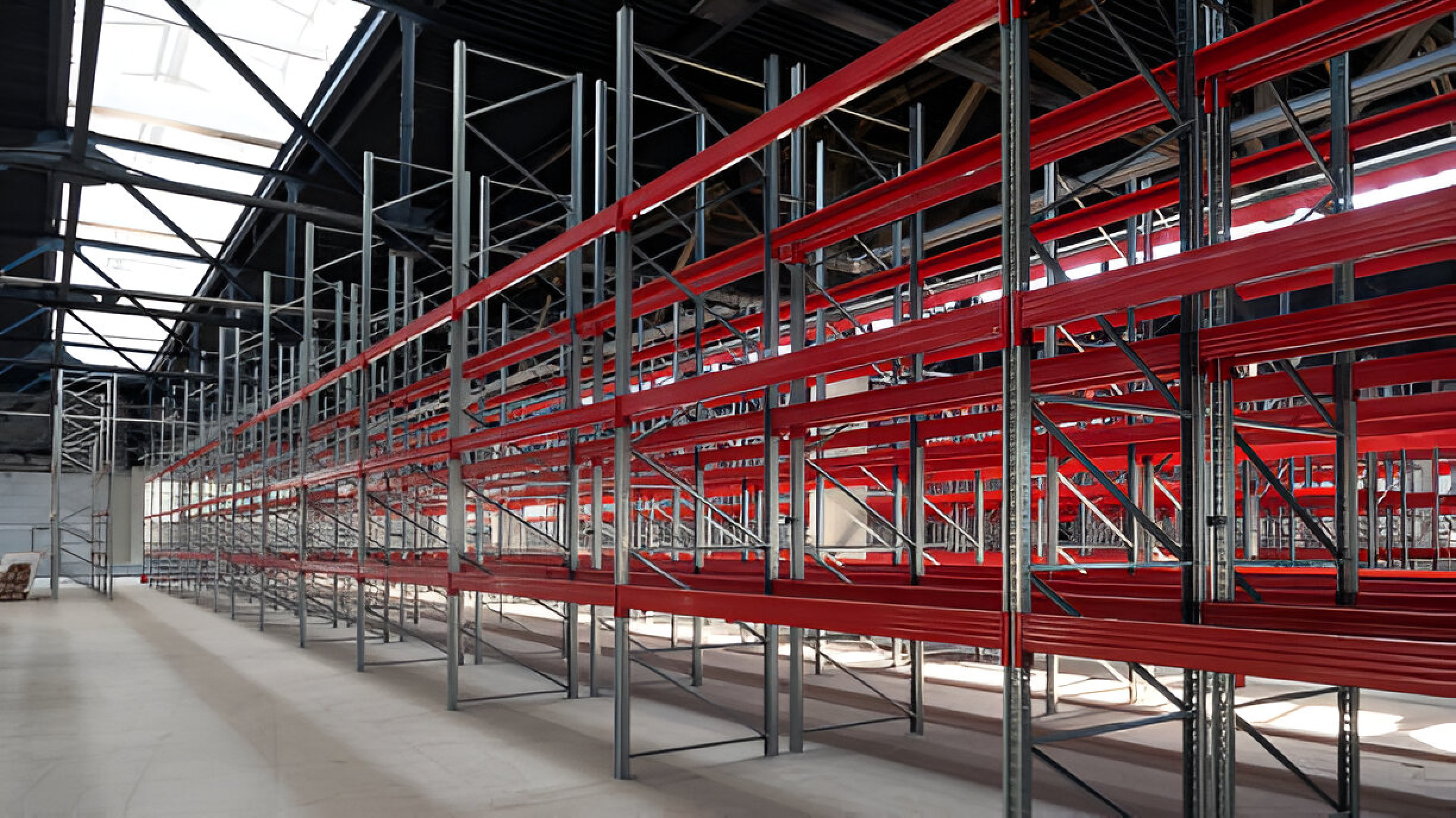
Selective pallet racking is the most widely used pallet racking system. It’s also what most people mean by “standard pallet racking”. Every pallet sits on its own beam level and can be reached directly by a forklift, and that simplicity is why you’ll find it in most warehouses across Canada.
How standard selective racking is built
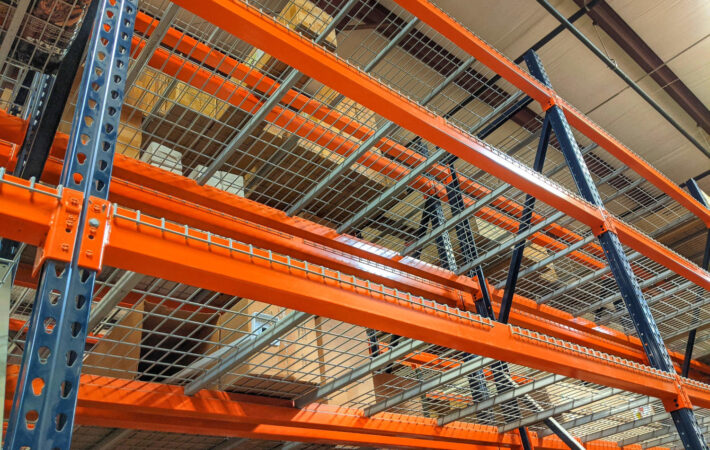
- Upright frames. Two steel columns joined by bracing, set at a depth to suit the pallet. A 42″ deep frame is common for a 48″ deep pallet, with the pallet overhanging the front and back beams slightly.
- Beams. Horizontal members that clip into the uprights and carry the load. Beam length sets how many pallets fit per level, and the beam profile sets the capacity.
- Beam locks. Safety clips that stop beams from being knocked out of their connectors.
- Wire decking or pallet supports. These sit on the beams to support loads and catch anything that would otherwise fall through. → Pallet rack accessories
- Anchors, guards and row spacers. These secure the system to the floor and protect it from forklift damage.
Selective racking comes in two common styles. Teardrop has bolt-free beam connections and is quick to adjust. Structural uses bolted, heavier steel sections for high-impact or very heavy use.
Why selective racking is the most common system
- Direct access to every pallet. No pallet has to be moved to reach another, which suits warehouses with many SKUs.
- Lowest cost per pallet position. It’s simpler to buy and install than high-density systems.
- Works with standard forklifts. Counterbalance and reach trucks both work, with no special equipment.
- Easy to change. Beam levels can be adjusted and bays added as needs change. Capacity has to be rechecked when levels move.
- Any stock rotation. You can run first in, first out or last in, first out, because every pallet can be reached.
The trade-off is space. Every row needs an aisle, so selective racking stores fewer pallets per square foot than drive-in, push-back or pallet flow racking.
When another type makes more sense
| If you… | Consider |
|---|---|
| Store large quantities of the same product | Drive-in / drive-through racking |
| Need more density but still want to pick from the aisle | Push-back racking |
| Need strict first in, first out rotation for dated stock | Pallet flow racking |
| Store long items like lumber, pipe or bar | Cantilever racking |
| Pick cartons and parts by hand | Wide span or boltless shelving |
For a full comparison, see our Warehouse Racking Systems Guide.
Frequently asked questions
What is standard pallet racking?
“Standard” pallet racking usually means selective pallet racking: upright frames and adjustable beams, with one pallet deep on each side of an aisle.
How tall can pallet racking be?
It’s limited by your building’s clear height (including sprinkler clearance), how high your forklift can reach, the frame design and the floor slab. Taller frames carry less per level unless they’re designed for it.
How much weight can selective racking hold?
It depends on the beam length and profile, the frame and the beam spacing. Your supplier should give you a rated capacity per level and per frame, and it should be posted on the rack.
Is selective racking good for small warehouses?
Yes. It can start with a few bays and grow. In very tight buildings, a double-deep or push-back layout may fit more pallets.
Do I need an engineer’s review in Ontario?
New racking that’s designed and tested to current standards, with documentation kept on site, is generally exempt from a Pre-Start Health and Safety Review. Exceeding the rated loads or modifying the system can trigger one. See does pallet racking need to be certified?
Talk to JB Equipment
We’ve supplied and installed selective racking across the GTA and Southern Ontario since 1985, from a few bays to full distribution centres. Browse pallet racking or request a quote.