The right racking system decides how much you can store, how fast your team can pick, and how safe the building is. This guide covers the main types of warehouse racking, how to choose between them, what to plan for before you order, and the Ontario safety rules that apply. JB Equipment has supplied and installed racking across the GTA and Southern Ontario since 1985. These are the questions we work through with customers on every job.
The main types of warehouse racking
Selective pallet racking
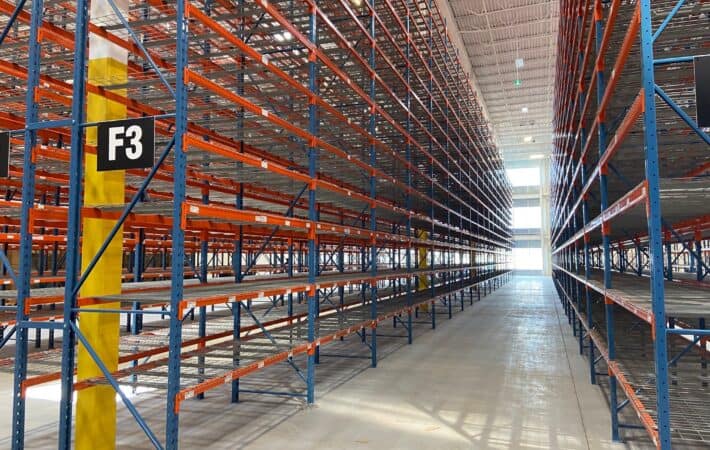
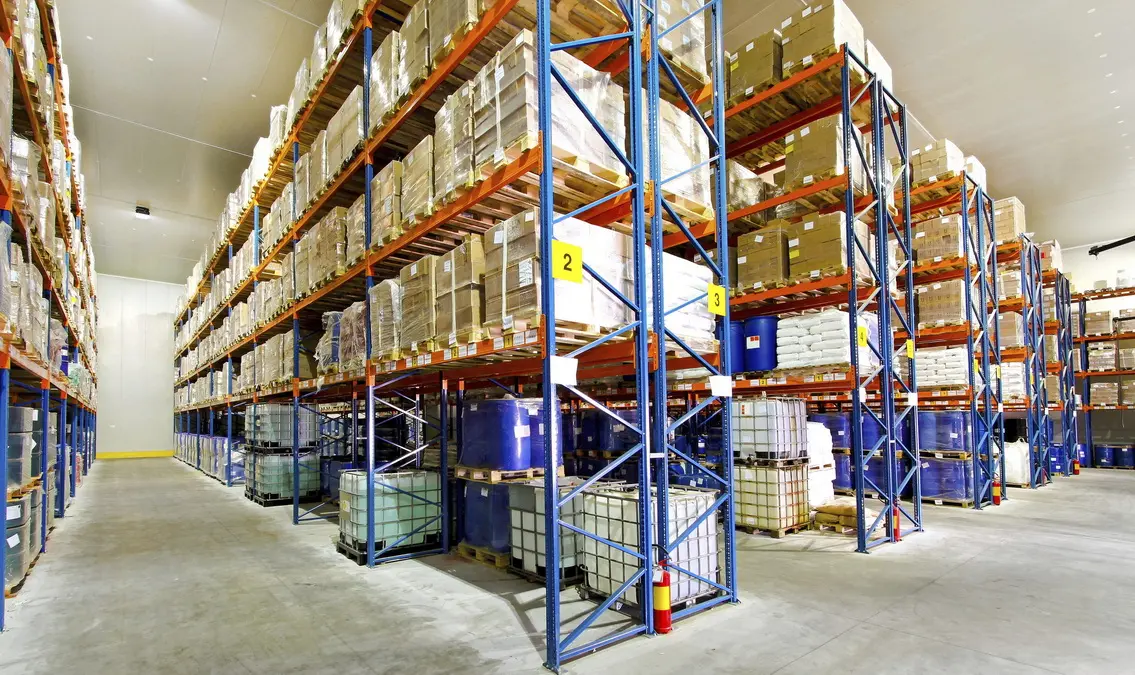
The most common system in Canadian warehouses. Every pallet sits on its own beam level and can be reached directly with a forklift, so there’s no moving one load to get to another. It suits warehouses with many different SKUs and works with standard counterbalance and reach trucks. It’s the least expensive per pallet position to buy, and the easiest to reconfigure or expand later. → Pallet racking
Drive-in and drive-through racking
Forklifts drive into the rack lanes and set pallets on rails, several pallets deep. This removes most of the aisles, so it stores far more pallets in the same floor space. Drive-in is loaded and unloaded from one side (last in, first out). Drive-through opens on both sides (first in, first out). It works best for large quantities of the same product, such as cold storage, beverage or seasonal stock.
Push-back racking
Pallets sit on nested carts on slightly sloped rails, usually two to five deep. Loading a new pallet pushes the others back, and when you take the front pallet out, the next one rolls forward. You get much more density than selective racking while still picking from the aisle face. It’s last in, first out.
Pallet flow racking
Pallets are loaded at the back and roll forward on gravity rollers to the pick face. This gives true first in, first out rotation, which matters for food, beverage, pharmaceuticals and anything with an expiry date.
Cantilever racking
Arms extend from a central column with no front uprights, so long or awkward loads like lumber, pipe, steel bar, sheet goods and furniture can be loaded from the side. → Cantilever racking
Mezzanines and rack-supported platforms
When floor space runs out but the building has height, a mezzanine adds a second working level for picking, light storage or offices. → Mezzanines
Shelving for hand-loaded items
Not everything belongs on pallets. For cartons, bins and small parts, wide span shelving or boltless shelving is usually cheaper and easier to pick from. See the difference between pallet racking and shelving.
Quick comparison
| System | Storage density | Access to each pallet | Stock rotation | Best for |
|---|---|---|---|---|
| Selective | Standard | Every pallet | Any | Mixed SKUs, general warehousing |
| Drive-in / drive-through | Very high | Lane by lane | LIFO / FIFO | Bulk quantities of the same product |
| Push-back | High | Front pallet of each lane | LIFO | Medium-volume SKUs, saving space |
| Pallet flow | High | Front pallet of each lane | FIFO | Food, beverage, dated stock |
| Cantilever | — | Every load | Any | Long or awkward items |
How to choose the right system
- What you’re storing. Pallet size, weight per pallet, and how many different SKUs you carry. Heavy, uniform loads point toward high-density systems. Many SKUs point toward selective racking.
- How stock moves. If product must leave in the order it arrived (expiry dates, lot control), you need first in, first out: selective, drive-through or pallet flow.
- Your building. Clear height to sprinklers and lights, column spacing, doors, and the floor slab. Racking anchors into concrete, so slab thickness and condition matter. See how thick concrete needs to be for pallet racking.
- Your forklifts. Aisle width depends on the truck. Counterbalance trucks need wider aisles than reach trucks, and very narrow aisle equipment needs its own rack design. Make sure the truck can reach the top beam level with a load on.
- Budget and growth. Selective racking costs the least per position and is easy to add to. High-density systems cost more per position but can save on a larger building. Leave room in the layout for the next expansion.
For a step-by-step version, see how to plan pallet racking and how to calculate pallet racking.
New or used racking?
Used racking can save money, but only if the parts are matched, undamaged and the capacity can be verified. Mixing brands or using frames with bent columns or braces is not safe. Without the manufacturer’s load information, the system may need an engineering review before use in Ontario (see below). For most permanent installs, new racking with documented capacities is easier to get approved and insure.
Ontario safety rules: PSRs and standards
In Ontario, storing material on a rack is covered by Section 7 of Regulation 851 (Industrial Establishments). Under it, a Pre-Start Health and Safety Review (PSR) by a professional engineer is required before new or modified racking is used, unless an exemption applies.
- The exemption. A PSR isn’t needed if the rack is designed and tested to current applicable standards and you keep the documents to prove it on site. Ontario’s PSR guideline names ANSI MH16.1 as the standard for this.
- When a PSR is needed. If the manufacturer’s load limits will be exceeded, a PSR is required to check the structure can carry the extra load. The guideline also says the requirement is triggered when existing racking is modified.
- CSA A344. In Canada, CSA A344, the user guide for steel storage racks, sets out good practice for buying, installing, loading and inspecting pallet racking.
JB Equipment provides layout drawings, load ratings and PSR coordination as part of our installation services. For more detail, see does pallet racking need to be certified? and do you need qualifications to install racking?.
Installation and upkeep
- Professional installation. Frames must be plumb, anchored and installed to the manufacturer’s tolerances. See how long installation takes.
- Load signs. Post the rated capacity on every rack run and train staff not to exceed it.
- Protection. Column guards, end-of-aisle guards, row spacers and wire decking reduce damage and falling loads. → Pallet rack accessories
- Inspections. Have staff check for bent uprights, damaged braces, missing beam locks and loose anchors regularly, and arrange a qualified inspection at least once a year. Unload and report damaged sections right away.
Frequently asked questions
What is the most common type of warehouse racking?
Selective pallet racking, because it gives direct access to every pallet and works with standard forklifts. More on why selective racking is most widely used.
How much weight can pallet racking hold?
It depends on the beam length and profile, the frame design, and the vertical spacing between beam levels. Every system should have a rated capacity per beam level and per frame. Ask for it in writing before you load the rack.
Do I need a PSR for new racking in Ontario?
Usually not, if the racking is designed and tested to current standards and you keep that documentation on site. You will need one if you exceed the manufacturer’s ratings or modify the system. See the section above.
How often should racking be inspected?
Have staff check it regularly, get a qualified inspection at least annually, and inspect right after any forklift impact.
Can racking be moved or reconfigured?
Yes. Selective racking is designed to be adjusted. But moving beam levels changes the capacity, so in Ontario the change should be checked against the manufacturer’s ratings, or reviewed by an engineer.
What areas does JB Equipment serve?
We’re based in Richmond Hill and supply and install racking across the GTA and Southern Ontario.